





What a Vietnamese phin does
A phin is a compact Vietnamese drip filter, usually made of metal. Coffee sits in a perforated chamber above your cup; a small press or insert rests on the grounds, and hot water passes through under gravity. Unlike an espresso machine, it does not use a pump. Unlike instant coffee, it brews roasted beans or ground coffee. The result depends on the coffee, grind, dose, water and how quickly the water drains.
Phin filters come in different sizes and designs, so treat any recipe as a starting point rather than a rule. A filter that holds more coffee may need a larger dose, and its holes and press can affect flow. If you are buying coffee for a phin, first check whether the pack contains whole beans or ground coffee. If it is whole bean, you will need a grinder.
A simple first brew
How do you use a phin?
- Set the filter over a cup or glass. Rinse it with hot water if you like, then discard that water; this warms the cup and filter.
- Add your coffee and level the surface gently. Place the press on top without tamping hard. A tight, compressed bed can slow or stop dripping.
- Pour a little hot water over the grounds to wet them. Wait about 20–30 seconds, then fill the chamber. Put the lid on and let the coffee drip.
- When dripping has mostly stopped, remove the phin and enjoy the coffee as brewed, or add milk, ice or another accompaniment to taste.
For a first try, use roughly 15 g of coffee with 90–120 ml of water. This is an illustrative starting range, not a KOKONIC product recipe or a universal standard. Try water around 90–96°C, then adjust the amount, temperature or steeping time to suit your coffee and phin. If the cup tastes too intense, use less coffee or more water; if it seems weak, change one variable at a time. A typical brew may take several minutes, but grind, filter design and pressing all affect the drip rate.
Choose a grind that lets water flow
What grind works for a phin?
A medium-coarse grind is a sensible place to start for many phins: coarser than a fine espresso grind, but not so coarse that water races through. The best setting depends on the filter and the coffee. If the brew stalls or drips unusually slowly, try a coarser grind or a lighter press. If water runs through very quickly and the cup tastes thin, try a slightly finer grind or a little more coffee. Change one thing at a time so you can tell what helped.
There is no reliable way to infer the grind from a product label or a photograph alone. Ask the shop what form is in the pack and whether its grind is intended for a phin. For whole beans, ask for a suitable grind only if you plan to brew the coffee soon; once ground, coffee loses freshness faster. For more background on choosing coffee for Vietnamese brewing, see the Vietnamese roasted coffee varieties guide.
Read the seven labels carefully
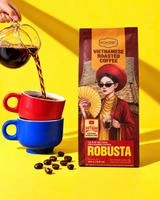
A label can help narrow your search, but it is not a complete specification. KOKONIC’s seven photographed labels—RO-HONEY, CULI, VIETNAMESE PHIN COFFEE, ARABICA, ROBUSTA, LUWAK and BLEND—appear against the same bright yellow background in images measuring 1122 × 1402 pixels, each showing coffee being poured into a cup. That consistent image style helps you recognize the range; it does not reveal a product’s grind, roast level, exact recipe or sourcing details.
| Label | What you can reasonably take from the name | What to check on the pack or with the shop |
|---|---|---|
| RO-HONEY | This is the product name shown. | The name alone does not prove honey processing or honey content. Check the stated ingredients and processing details. |
| CULI | “Culi” commonly refers to peaberry coffee. | Confirm what this particular pack means by CULI, along with its bean form and brewing guidance. |
| VIETNAMESE PHIN COFFEE | The label presents it as Vietnamese phin coffee. | Do not assume it is ground, or that its grind suits your filter; verify the pack details. |
| ARABICA | Arabica is a coffee species/type. As a general tendency, Arabica is often described as more aromatic. | Do not treat that tendency as a tasting note for this particular product. Check the actual product information. |
| ROBUSTA | Robusta is a coffee species/type. As a general tendency, Robusta is often associated with a stronger impression. | This is not a guaranteed product-specific taste description; check the pack and ask about brewing. |
| LUWAK | This is the name printed on the product. | The name alone does not establish authenticity, source or provenance. Look for clear, verifiable product details rather than assuming them. |
| BLEND | The visible pack states 40% Robusta and 60% Arabica. | That ratio is the supported information; do not infer further ingredients, processing or tasting notes without details. |
These are useful distinctions when comparing bags, but not a reason to guess at what is inside. For a broader comparison of the two species and blends, read Arabica vs Robusta: a Vietnam coffee blend guide. For other options and buying context, see seven Vietnamese roasted coffee varieties in Saigon.
Choose coffee for the person receiving it
What makes a good coffee gift?
Start with the recipient’s brewing setup, not a grand claim on the front of a bag. A phin user may appreciate coffee they can grind for their own filter; someone without a grinder may prefer a clearly labeled ground option. Confirm the package’s contents and directions before purchase. If the recipient likes choosing a recipe, whole beans offer that flexibility, but only if they have a grinder.
For a gift, check the sealed-pack condition, net weight, ingredient information and storage directions. Avoid presenting a product name as proof of a particular process, ingredient or source. If the recipient is new to Vietnamese coffee, include a phin or a short brewing note only if you know the coffee form and the advice matches its packaging. More ideas are in this Vietnamese coffee souvenir guide for Ho Chi Minh City.
Avoid common brewing and buying mistakes
- Assuming roasted coffee is instant: roasted whole beans or ground coffee need brewing; instant coffee is a different product.
- Buying the wrong form: check whether you are buying beans or grounds, and whether you have a grinder.
- Using an unsuitable grind: fine grounds can clog a phin; very coarse grounds may drain quickly. Adjust gradually.
- Pressing too firmly: the insert should sit on the coffee, not compact it like an espresso puck.
- Treating labels as guarantees: names such as RO-HONEY, CULI or LUWAK do not, by themselves, establish processing, composition or provenance.
- Changing everything at once: adjust grind, dose or water separately to learn what changes the cup.
Before you buy or brew, check:
- [ ] Whole bean or ground—and do you have the equipment you need?
- [ ] Is there a grind recommendation or phin brewing direction on the package?
- [ ] Are ingredients, net weight and storage instructions clear?
- [ ] Are you relying only on a product name for a claim the pack does not confirm?
- [ ] For a gift, will the recipient be able to brew this form of coffee?
Store coffee well and check travel rules
Keep roasted coffee sealed, dry and away from heat, sunlight and strong odors. Follow the package’s storage directions, and avoid transferring it to an unlabeled container if you may need to check its ingredients or product details later. Ground coffee generally loses freshness faster than whole beans once opened, so buy a form and quantity the recipient can use in a reasonable time.
Coffee is a popular travel purchase, but baggage and import rules vary by airline and destination. Check current rules for your route, including any requirements for food products and carry-on or checked baggage; do not assume that a sealed pack is automatically permitted everywhere. Keep the original label available for inspection.
Where to find KOKONIC in Ho Chi Minh City
Travel Saigon is operated by KOKONIC. You can visit these shops and check current location information on the KOKONIC store page: 8 Đồng Khởi, Grand Hotel Saigon; Level 3, 42 Nguyễn Huệ, The Cafe Apartment; 113Bis Xuân Thủy, Thảo Điền; and 116 Hồ Tùng Mậu. Ask staff to confirm the specific pack’s bean or ground form, grind, brewing directions and storage details before choosing. A few practical questions can make the difference between a useful gift and a bag that does not suit the recipient’s equipment.